Estate Cleanout Checklist for Huntingdon Families
Clearing out a family home in the Huntingdon area is rarely just a hauling job. This checklist covers sorting, donation, disposal, and dumpster sizing so the practical side is easier to manage.
Huntingdon dumpster guide
Different construction materials behave very differently in a roll-off container. Here's how to size and load your next Huntingdon-area job correctly the first time.
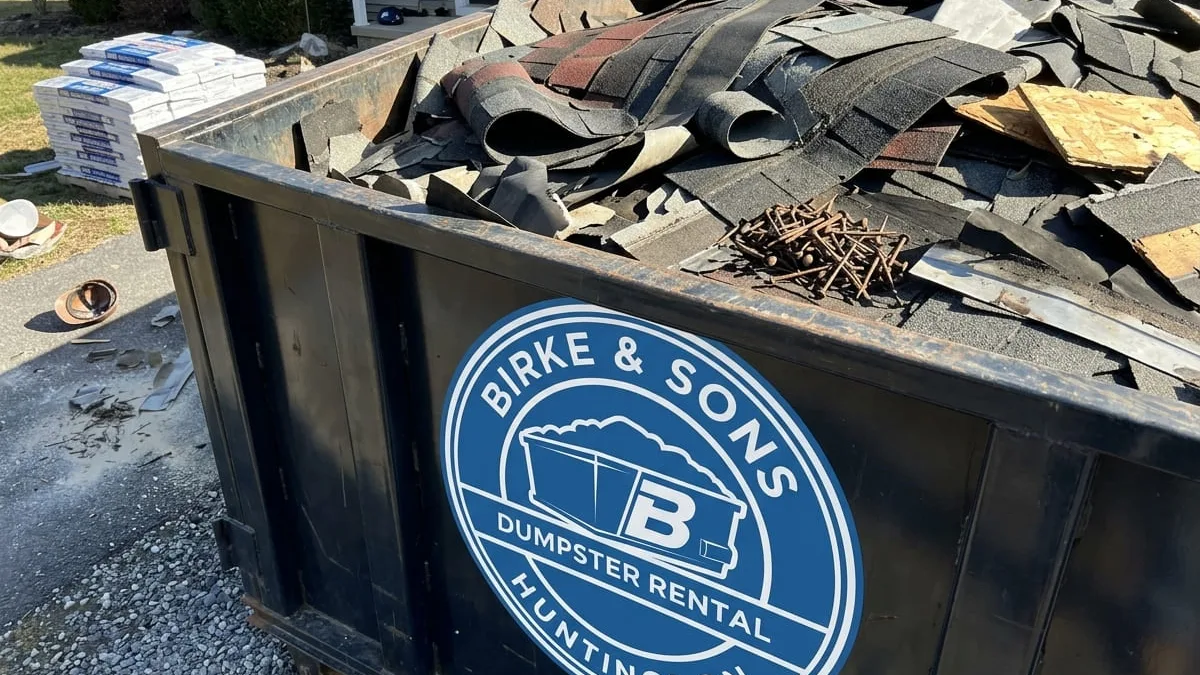
Contractors working around Huntingdon and the wider Juniata Valley deal with a wider range of debris than most residential customers — drywall one week, roofing tear-off the next, concrete footings the week after that. Each of those materials behaves differently in a roll-off container, and getting the size and load strategy right saves real time and money over the course of a job. This guide walks through the debris types we see most often on job sites, how to size for them, and where weight becomes the deciding factor instead of volume.
Drywall, wood framing, trim, and general interior demo debris are some of the most common loads we haul for construction dumpster rental customers. This category is relatively light per cubic yard compared to concrete or shingles, which means volume — not weight — is usually the limiting factor. A single-room remodel typically fits comfortably in a 15-yard dumpster, while a multi-room gut job or a full interior demo on an older Huntingdon-area home often calls for a 20-yard or 30-yard dumpster. Broken-down drywall and framing pack down well, so taking a few minutes to break long pieces down before loading gets meaningfully more material into the same container.
Roofing is its own category, and it deserves its own container in most cases. A layer of asphalt shingles is dense — often the single heaviest material by volume that a residential job produces — so a roofing tear-off will hit a weight allowance well before it fills a container by volume. For a standard single-family roof, a 20-yard dumpster booked through our roofing dumpster rental service is the typical starting point, sized specifically around that weight-to-volume relationship rather than around how much space the shingles physically take up. Multi-layer tear-offs (a roof with two or three layers of old shingles underneath the current one) run heavier still, so it's worth mentioning layer count when you book so we can size accordingly. Keeping roofing debris in its own dedicated load, rather than mixing it with lighter framing or drywall waste, is almost always the more efficient approach.
Concrete and masonry debris is the clearest example of why volume and weight are separate questions. A modest pile of broken concrete from a driveway or footing removal can weigh as much as a much larger volume of lighter debris, which is why we generally recommend a smaller, dedicated container — often a 10-yard or 15-yard dumpster — specifically for concrete, brick, or masonry rather than mixing it into a larger general-debris load. Our concrete and heavy debris service is built around exactly this: right-sizing the container to the material's weight, not just its footprint, so you're not paying to hit a weight overage on a box that still has visible room in it.
A full structure demolition — tearing down an outbuilding, garage, or entire home — mixes all of the above: framing, drywall, roofing, sometimes concrete foundation material, plus flooring, fixtures, and whatever else has accumulated in the structure over the years. Because of that mix, these jobs often work best with more than one container, or a larger box like a 30-yard or 40-yard dumpster for the bulk of the lighter material, paired with a separate smaller container for concrete or foundation debris if the job includes it. Our demolition debris service is set up to handle exactly this kind of mixed, multi-phase job — we'll talk through what the structure includes before delivery so the sizing matches the actual project, not just a rough guess.
For projects that run over multiple weeks with several trades on site — a full renovation or a small commercial build-out — a single container often needs to be swapped out partway through rather than filled once. That's a normal part of a longer job, and it's worth planning for from the start rather than discovering mid-project that the box is full and the job isn't. Our commercial dumpster rental accounts are set up around this kind of ongoing need, with swap-out scheduling built into the rental rather than treated as an exception.
Standard construction and demolition debris — wood, drywall, flooring, roofing, masonry, non-asbestos insulation — is fine in any of our containers, sized appropriately for weight. A few materials that sometimes turn up on a job site need separate handling under Pennsylvania law: electronics like old computer monitors or a job-trailer television fall under the state's Covered Device Recycling Act and can't go to a landfill, and any hazardous material — old paint, solvents, adhesive chemicals — should never go in a roll-off at all. Our full breakdown in what can go in a dumpster in Pennsylvania covers this in detail, and it's worth a quick read for any job site that's likely to turn up something outside standard construction debris.
The most efficient job sites are the ones where sizing gets sorted out before the container shows up, not after the first load is already piling up. If your project is on private property — a driveway, yard, or job-site lot — no permit is needed regardless of size. If the job is tight enough that the container needs to sit in a street or right-of-way, our Huntingdon dumpster permit guide walks through exactly when that applies and who to contact town by town.
Every job site is a little different, and the fastest way to get the right size and the right number of containers is a quick conversation before delivery. Call Birke & Sons Dumpster Rental Huntingdon at (814) 907-3647 and walk us through what the project involves — material types, rough scope, and timeline — and we'll recommend a setup that keeps your job moving without paying for capacity you don't need. Need it fast? Ask about our same-day dumpster rental option for jobs that can't wait on a standard delivery window.
FAQs
A 20-yard dumpster is the typical starting point for a standard single-family roofing tear-off, sized around the weight of asphalt shingles rather than the volume they take up. Multi-layer tear-offs run heavier, so mention the layer count when you book.
Generally no. Concrete and masonry are dense enough to hit a weight limit long before a container fills by volume, so a smaller, dedicated container is usually the more efficient choice than mixing it with lighter framing or drywall debris.
It depends on the mix of materials. A full structure demolition often includes both lightweight debris (framing, drywall, roofing) and heavy material (concrete or foundation debris), which sometimes works better as a larger container for the bulk material plus a separate smaller one for concrete.
For multi-week jobs, a container swap partway through is normal and can be scheduled as part of the rental rather than treated as an exception — this is common on our commercial dumpster rental accounts.
No. Pennsylvania's Covered Device Recycling Act bars landfill disposal of computers, monitors, and televisions statewide, so these need a certified electronics recycler rather than a roll-off dumpster, even on a job site.
Not if it sits entirely on the property — private-property placement never requires a permit anywhere in our service area. If the job site is tight enough that the container needs to sit in the street, see our Huntingdon dumpster permit guide for what applies in your specific town.
Ready when you are
Call and you will speak to someone local who knows the streets, the permit rules and which box actually fits your lot. Flat rate quoted up front.
Keep reading

Clearing out a family home in the Huntingdon area is rarely just a hauling job. This checklist covers sorting, donation, disposal, and dumpster sizing so the practical side is easier to manage.
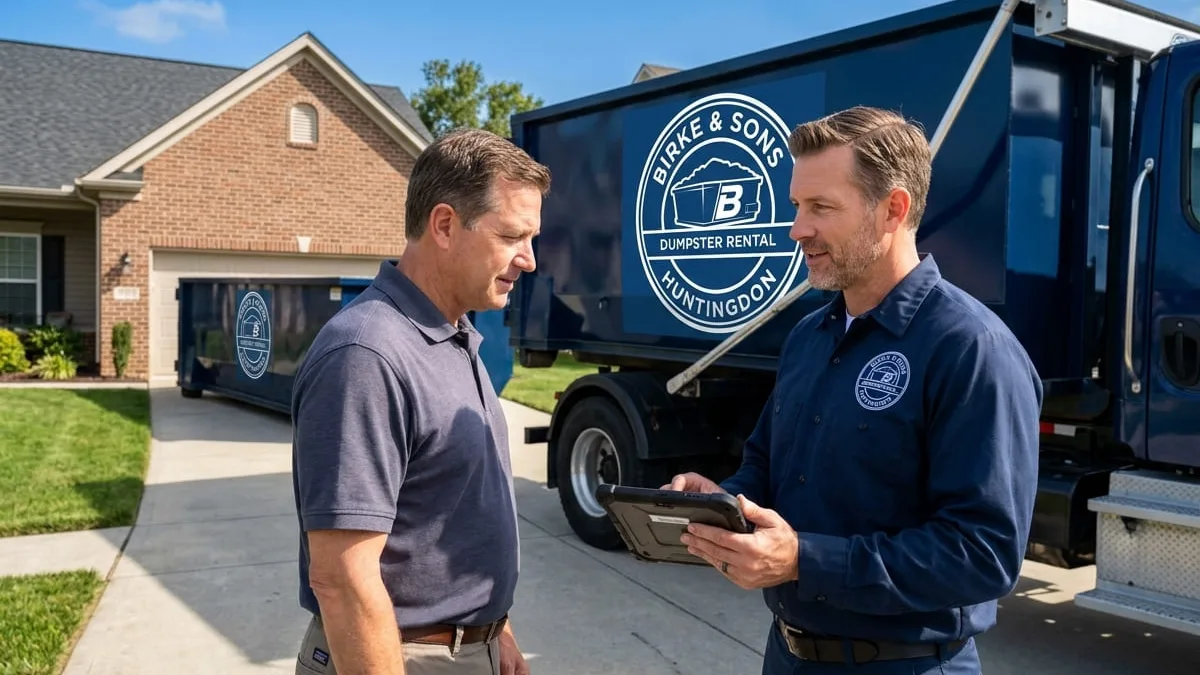
Shingles are heavier than they look, and a roof with more than one layer changes the math fast. Here's how to size the container correctly for a Huntingdon-area tear-off.
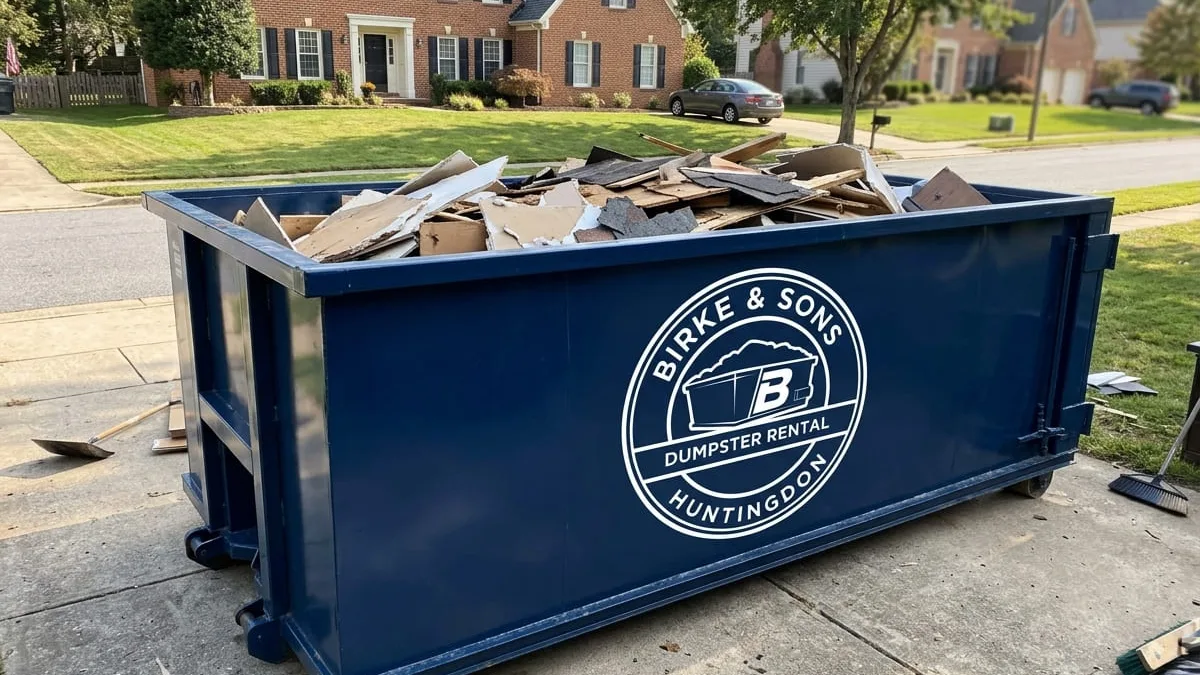
The weather risk that actually shapes dumpster scheduling in the Huntingdon area is river flooding and winter ice, not high wind. Here's what that means before and after delivery.